Artificial intelligence is everywhere in recruitment. Automatic matching, candidate scoring, job ad writing, predictive sourcing… To hear some vendors tell it, you'd almost think AI will soon recruit in your place while you sip a coffee watching LinkedIn run by itself.
Spoiler: we're not there yet.
But behind the buzz, a real question deserves to be asked: does AI actually improve hiring quality… or does it only let you move faster? Here is our analysis, point by point.
What AI Really Improves in Recruitment
Let's start with the positive, because there is plenty of it. AI is not just a well-marketed buzzword: on certain specific tasks, it brings real value. A quick overview:
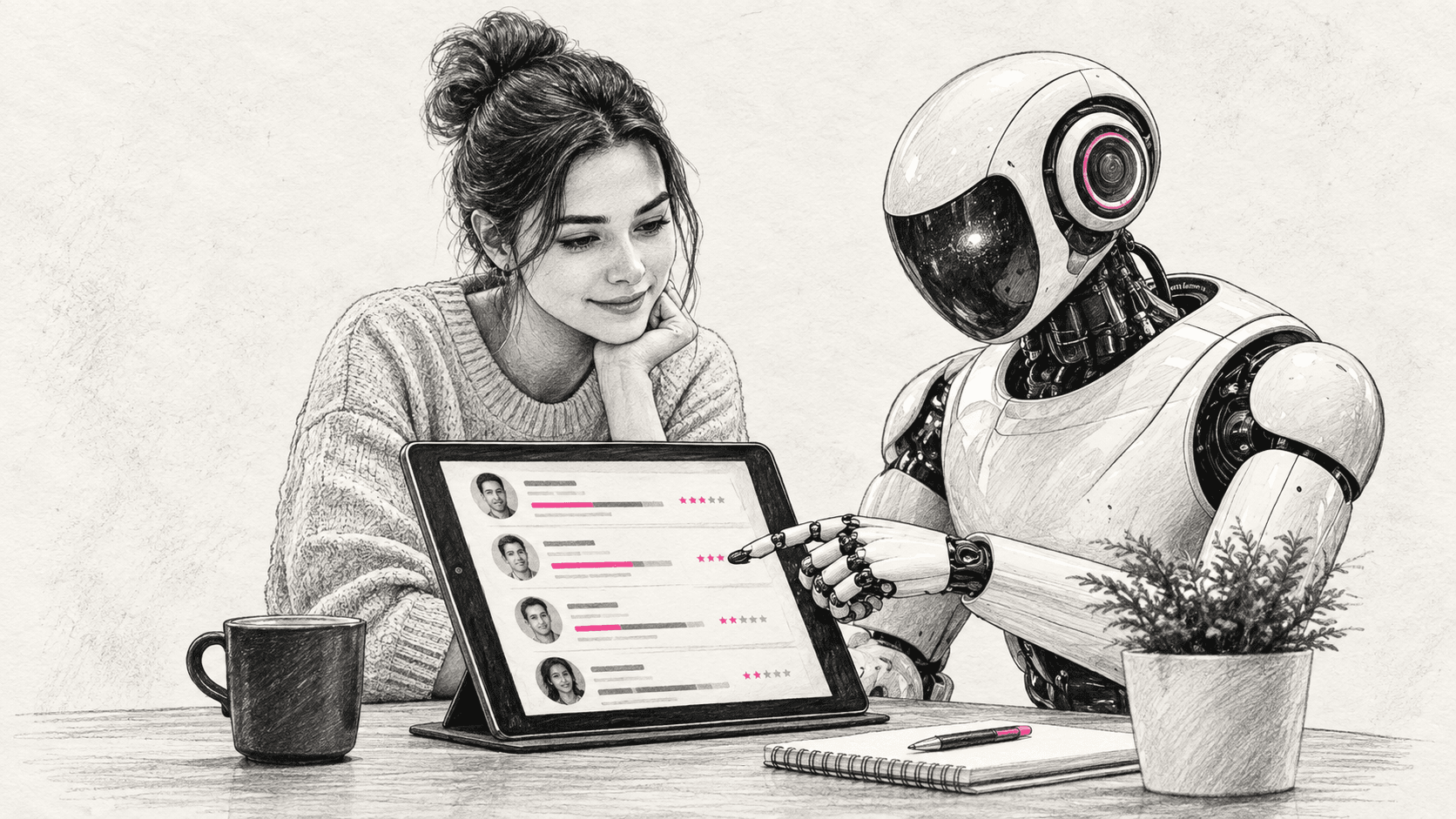
- Application screening. When a position attracts 800 CVs, reading them by hand is a labor of devotion. Fortunately, today, AI does the rough sorting, ranks, and surfaces relevant profiles. It's not always perfect, but it's infinitely more reliable than a recruiter exhausted by the 200th read.
- Candidate sourcing. Finding the right profiles has become a sport in its own right. AI scans LinkedIn, CV databases, GitHub or internal databases and surfaces candidates nobody would have identified searching by hand, including passive talent. A real gain, especially for hard-to-fill roles, where the talent pool is dry.
- Writing job ads. No more starting from a blank page. AI proposes a framework, suggests more inclusive wording and spots the jargon that scares people away. You still need to proofread and personalize, but the time savings are real.
- Standardizing evaluation. Same questions, same criteria, same grid for all candidates. Gone is the interview where one is grilled on technical skills while the other chats football with the manager. It's not very romantic, but standardization remains the foundation of fairness.
- Reducing certain human biases. Certain ones, we insist. A well-designed AI knows neither end-of-day fatigue, nor the halo effect ("they went to the same school as me, nice"), nor the cognitive bias linked to a photo or a first name. It also makes it possible to reason more by real skills than by academic pedigree. Good news for atypical profiles, self-taught people and career changers, who often went under the radar of traditional grids. Provided, always, that it is well designed. But that's for the next part.
- Predictive decision support. Some tools analyze the company's history (who stayed, who performed, who was promoted) to refine the targeting of future hires. But for that, (once again) the historical data must not itself be biased.
- Automating all the small time-consuming tasks. Scheduling interviews, following up with candidates, answering standard questions via chatbot, taking notes during conversations: so many tasks that ate up a recruiter's day without adding much to the quality of the final choice.
Hard to deny it: on all these aspects, AI improves hiring quality, and not just a little. But the picture still deserves some nuance.
AI's Blind Spots
AI improves many things, but it also introduces its own problems. And some are serious.
Here are the limits that are often glossed over in the nice PowerPoint presentations:
- Algorithmic bias. The example has become a textbook case: Amazon had to abandon its CV screening tool because it systematically discriminated against women. Not out of malice, just because it had learned from ten years of male-dominated hiring and concluded that being a man was a success criterion. Moral of the story: an algorithm fed with biased data produces biased decisions. Only worse, because at scale and with a veneer of objectivity.
- The black box effect. Why was this candidate ruled out? Often, nobody can answer, not even the recruiter using the tool. Yet rejecting someone without being able to explain why is problematic ethically, and downright risky legally (GDPR and the European AI Act are clear on this).
- Speeding up the "bad process". What you need to keep in mind is that AI executes, it doesn't think. It applies what you give it (your criteria, your job description, your sourcing strategy). And it doesn't question any of it. Result: if these foundations are solid, it saves you precious time. If they're shaky, it rolls out the shakiness at high speed.
- Dehumanizing the candidate experience. Receiving an automatic rejection with no explanation after a video interview taken in front of a camera analyzing your micro-expressions rarely leaves a lasting memory. Candidates feel it, talk about it, and the employer brand suffers. Not to mention those who learn to "game" the algorithm, for example by stuffing their CV with keywords.
The conclusion is clear: used without discernment, AI can degrade hiring quality.
So, Does AI Really Improve Hiring Quality?
Yes… provided you treat it as a copilot, not as an autonomous recruiter.
The mistake many companies make is expecting AI to replace human judgment. Yet the best results appear when it is used only to "augment" recruiters: automating repetitive tasks, structuring data, finding the right profiles faster and freeing up time for what really matters, that is, understanding candidates, challenging needs and building a real relationship.
Because deep down, a good hire doesn't rely solely on keywords or a matching score. It also relies on weak signals, context, industry intuition and the ability to picture a candidate within a team and a culture.
And no AI knows how to do that.
The most interesting tools today are therefore not those that promise to "replace" recruiters, but those that make them better. That is precisely the philosophy of solutions like T4S: using AI to reduce mental load, make processes more reliable and speed up searches, while leaving the important decisions to humans.
In short: AI will probably not replace recruiters. But recruiters who know how to use AI well are very likely to replace the others!