
Introduction
Every day: a new funding round, a new AI recruitment player, a new paradigm.
These giant fundraisings (recently Metaview $60M, Jack & Jill $40M or JuiceBox $80M), and their escalating enticing promises give us the feeling that something irreversible has happened. That the market has tipped into a new era that completely eradicates traditional practices. That everything that isn’t “AI-native” is no longer of this world. That recruiters who stick to traditional practices are “has-beens”.
We are caught up in this game too: AI is at the heart of concerns. Neglecting AI means making sure you are undesirable, and taking the risk of being left behind in a few years. So with Collective.work, we chose to join the AI players’ camp, and to go all in.
Nevertheless, by also offering a range of traditional tools (e.g. Boolean search, keyword search, CV database) alongside AI tools, we can clearly gauge the resilience of the customary practices of the recruiter’s profession.
The conclusion in two words: traditional search still has value, contrary to what one might believe. AI is revolutionizing the profession as a whole, but good or bad habits resist it.
A few figures
Today, a little over 20,000 recruiters are registered on Collective, with uneven usage (a few searches a month for occasional recruiters, up to several dozen searches a day for the most active ones).
All types of recruiters are represented:
- Recruitment firms / Executive Search (e.g. Page, Hays, Morgan Philips…)
- Interim management firms (Valtus, X-PM, Grant Alexander, OMS…)
- Temp staffing agencies (Randstad, Actual, Mistertemp, Adecco…)
- Service companies (CGI, OnePoint, Devoteam, Theodo…)
- Corporates (Casino Partouche, Partoo, Vinci, Adeo…)
- Specialists (freelancers, small firms…)
These 20,000 recruiters are mainly located in France, Belgium, Luxembourg, Morocco, the United Kingdom and Spain (95% of activity) and marginally in other geographies.
They can do sourcing there (AI → Sherlock or Traditional → MegaSearch) or job ad distribution (with or without AI assistance).
On the sourcing side, recruiters always have the choice between an AI search via the Sherlock tool (based on natural language prompting or similar-profile search) or a traditional search via the MegaSearch tool (Boolean + filters).
If we believe the ambient noise of LinkedIn posts, we should expect traditional search to disappear completely in favor of AI search. And yet both continue to grow very quickly, and traditional search is still the dominant usage. Today, we observe: ~200-500K Boolean searches per month, versus ~20K AI prompts.
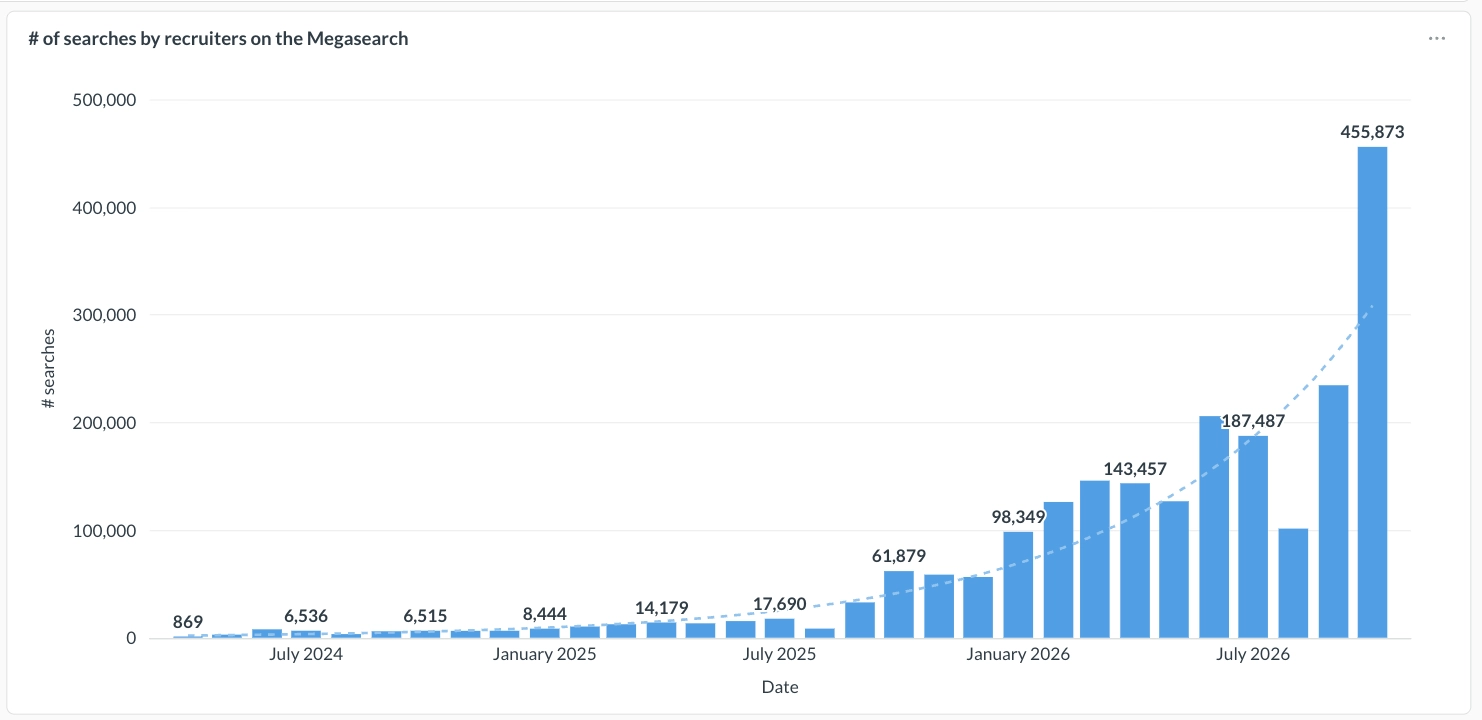
Number of Megasearch queries per month, made by recruiters on Collective.work
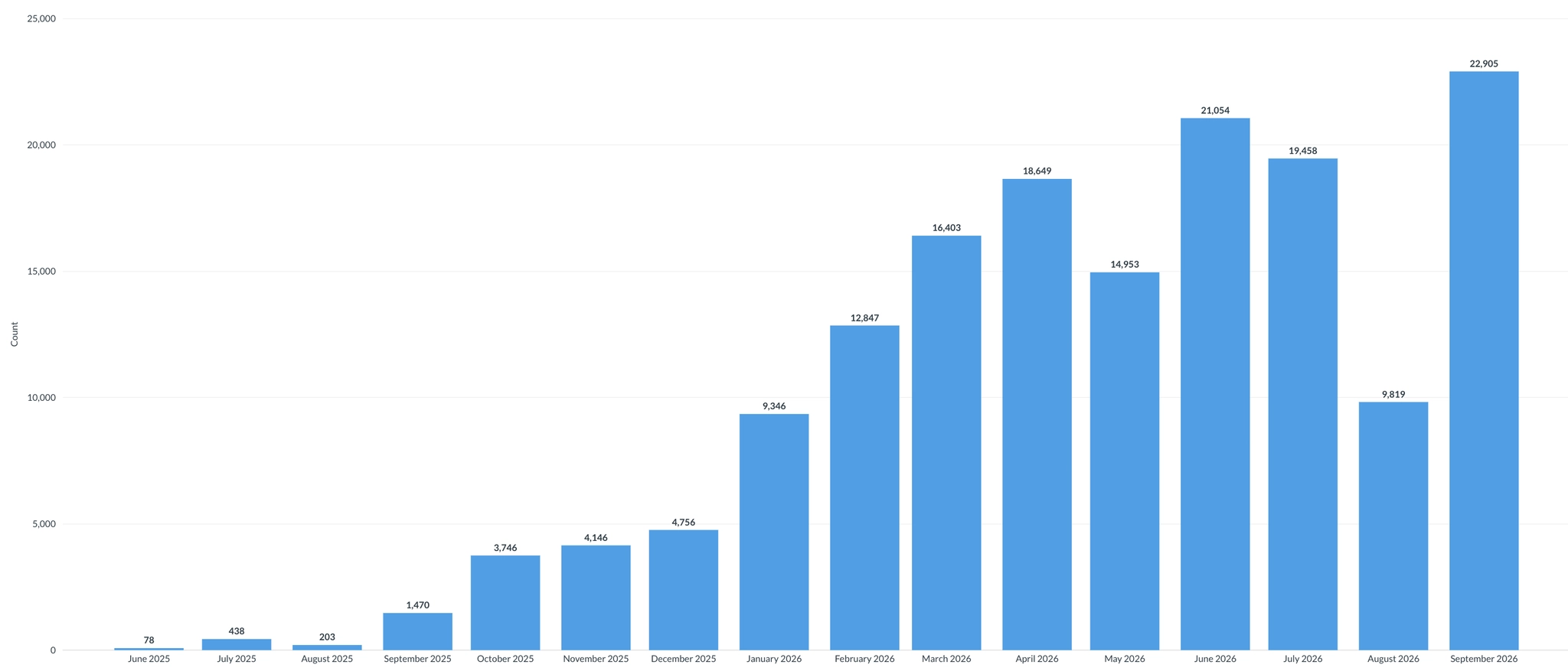
Number of AI searches (Sherlock) per month, made by recruiters on Collective.work
At first reading, one might almost be surprised by the overwhelming dominance of Boolean search and hastily conclude that AI search is of almost residual interest.
A closer analysis of these figures, however, calls for nuance.
A bit of analysis on traditional vs. AI search
In reality, these figures in absolute terms are rather reductive. There are important points to make in order to nuance the analysis.
- How AI works. AI search (at least Collective’s) runs between 10 and 20 different Boolean queries (depending on the effort level set by the recruiter and the complexity of the search), so it is logical to see 1 AI prompt for 10-20 AI searches.
- Business model. Today, AI search consumes tokens and therefore generates a cost, whereas traditional search is free. As a result, usage on Collective is limited by AI credits and therefore encourages users to be economical and use it only when relevant.
- Time spent. Changing a keyword in a Boolean query takes less than a second, whereas writing a prompt can take a minute. Boolean searches simply let you count a population in half a second and the recruiter quickly modifies the content of the search to see how the results change.
Qualitatively, recruiters today are more impressed by the results of AI search (they are also more demanding of it) than by well-proven traditional search.
For more complex roles (the five-legged 🐑) with many constraints that are hard to sum up with keywords, recruiters favor AI search. A few examples:
“I am looking for an AI project manager who has already worked in a digital transformation context, who has an appetite for finance or investment, and who has already managed a team”
“I am looking for a Data engineer who was previously a developer, who has already worked in a startup (post Series A), in a high-growth context, and who has an engineering degree”
“I am looking for a CFO who has already worked for a company under LBO, who has already led an M&A operation or an exit, who has experience in a BIG 4 or a CAC 40 company”
In these 3 cases, Boolean is limited, whereas AI is able to understand and identify profiles very quickly.
For roles that are easier to codify (a developer mastering a very specific technology, an expert in a specific tool,…) traditional search remains the first reflex.
In summary
The magic of the LinkedIn enchanters that we sometimes are does not reflect the entire market. It reveals what is starting to happen, the disruptions taking shape. But it also tends to confuse what is emerging, what is impressive and what is actually used day to day.
AI sourcing is progressing fast, is convincing on use cases where traditional approaches reach their limits, but does not replace traditional search for all that. The two coexist, progress, and meet different needs.
That is perhaps where the real challenge lies for recruitment players: not replacing old methods with new ones at all costs, but giving recruiters the means to choose the right approach at the right time.
In the meantime, we will keep seeing funding rounds of several tens of millions, announcements of imminent revolution and LinkedIn posts announcing the death of traditional sourcing.
But in the field, Boolean has not said its last word.